I've taken a break from most social media. And I had stopped following US politics before Elon Musk got involved in the election cycle.
Still here's my prediction: Trump will win.
Here are my reasons:
1. If you follow news on Twitter, there are lots of credible polls that suggest Trump will get an electoral college win. There are also pollsters like Atlas Intel and Emerson who predict Trump winning every swing state. Some of the cautious observors like Mike Halperin and Robert Cahaly also think Trump will win, even if they rule out a 7 swing state sweep for Trump. Even seemingly "mainstream" polls suggest a tie or small Harris leads well within the margin of error.
2. Then there is early voting numbers. Republicans have massively changed their game and have put effort into early voting. This is in stark contrast to 2022, where they foolishly let Democrats repeat the vote by mail circus and failed to win the Senate.
3. I don't think Elon Musk will stick his neck out like this, only to lose. Jeff Bezos, Tim Cook and Mark Zuckerberg have also tried to play safe. [All credible] Polls are unanimous - Trump has the edge. And Peter Thiel, who I believe is heavily involved in Trump's campaign, will not make the 2022 mistake again.
Why I and many others could go wrong:
1. Elections cannot be won when a huge voting population is livid. Women are still furious about the US Supreme Court setting Roe v Wade aside. Trump should have had a woman running mate. I have long suggested Joni Ernst. JD Vance brings zero new votes to Trump but infuritates women further. I don't think this pro-abortion vote is a game changer, but if Harris wins, it'll be because of this women vote.
Will Trump's second term be good?
As I joked few months ago, I don't want MAGA. I don't want "America" to become great again. I want MAMI. Modify America with Mass Immigration. I want USA to remain an economic colony (like Australia) without geopolitical hegemony.
Trump's presidency was one of the best for the world, because he did not start new wars and pursued peace to a large extent (Abraham accord, North Korea etc). But his policy towards Palestine is a red flag. I don't think Trump will even do lip service to Free Palestine and instead allow Israel to continue its genocide in Gaza. Israel has no right to exist and every Zionist occupying Palestine must be sent back to the countries they came from. It's possible Democrats embrace the Free Palestine cause more to spite President Trump, but I'm not too optimistic.
Also, the idea that USA should have tighter immigration is just wrong. USA is a colony and Americans (I mean those in Central and Latin America) should have the right to the lands and wealth of USA, even if its the white colonialists who created the wealth.
Let's see what the future and Tuesday have in store.
Showing posts with label Politics. Show all posts
Showing posts with label Politics. Show all posts
Monday, November 04, 2024


Thursday, April 11, 2019
Why I'm voting for Krishna Byre Gowda
I’ll be voting for Krishna Byre Gowda of Congress as my representative in the Loksabha from Bengaluru North.
I wrote down the reasons for my vote on a recent flight, ironically to Ahmedabad.
I’ve been voting since 2001 TN assembly elections and till 2014 had voted for more than 10 different parties, but not Congress. In 2014, I voted Nandan Nilekani for MP. In 2018 Karnataka Assembly election, I shamefully voted for a nobody from Congress, because I badly wanted Siddaramaiah Govt to be re-elected.
So, this is the 3rd time in a row, I’ll be voting for Congress!! This is surprising for someone who was a BJP supporter all my youth, and still am absolutely disgusted by Congress dynasty politics. There is no politician I hate more than Rahul Gandhi.
Krishna Byre Gowda is the son of a former minister too, and ‘inherited’ the MLA seat upon his father’s death. In 2009, I voted against him in Bengaluru South because I thought he was a dynast.
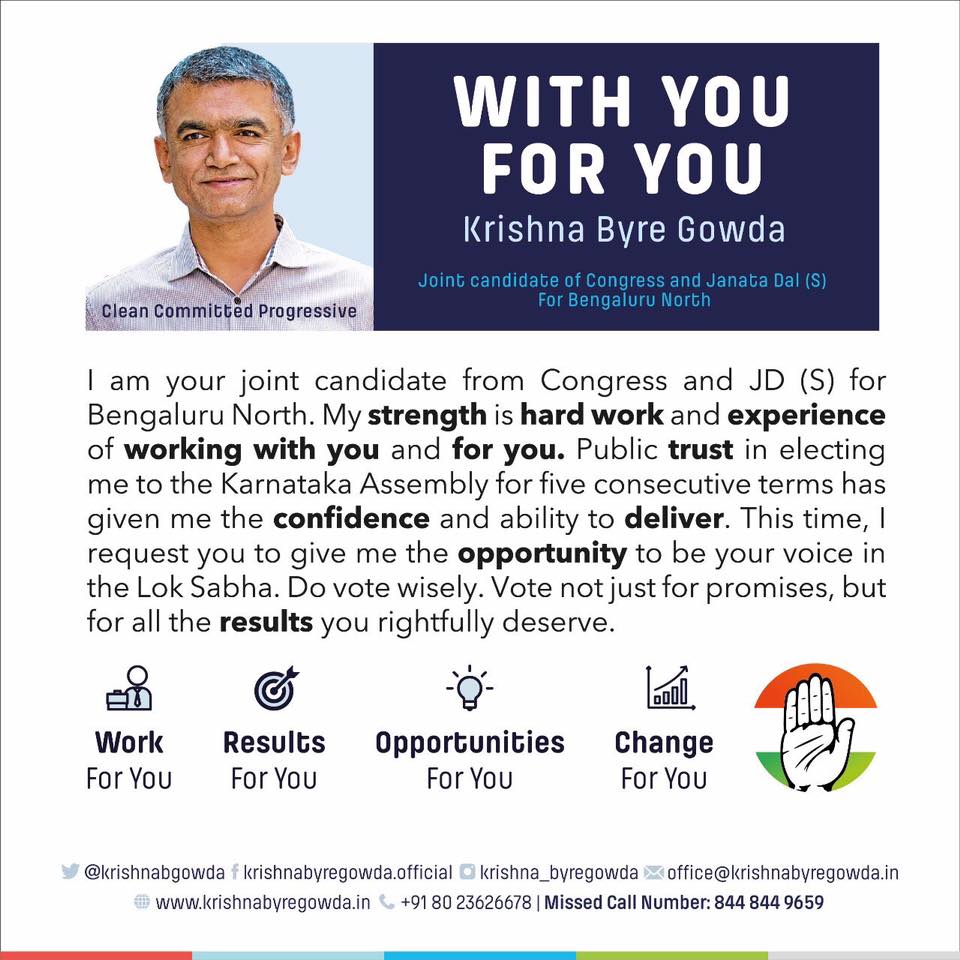
But I have since followed Krishna Byre Gowda (KBG), to find that he is an incredibly nice person, an intelligent politician, and easily the best minister in the Karnataka Govt.
As agriculture minister, his work on farm ponds, agricultural equipment renting scheme, supporting millet farming etc were extremely important in a state that faced successive droughts. He also represented Karnataka in the GST council.
KBG is now bringing the same rigour to Rural Development ministry, reviving water bodies and focusing on NREGA jobs with Secretary L K Atheeq, who is a very capable administrator himself.
One winter day in 2017, with flights delayed due to fog, I saw KBG wandering alone in Bengaluru airport with a book in his hand. I thought it was ok to disturb him and we talked politics for nearly an hour!
I’m absolutely delighted to be voting for Krishna Byre Gowda.
***
I do usually encourage people to vote for the best candidate on the ballot and not worry about the parties. Not this time. Please do not vote for BJP. Anyone contesting on a BJP ticket, is displaying poor judgement at best, a bigot on average, or a Hindutva terrorist at worst.
Narendra Modi has led a shit government which has run the economy to ruin. No one believes the fake GDP numbers. India is growing at 5 percent or less. There is a massive jobs crisis. In a country with the most poor people in the world, Modi Govt’s economic performance is absolutely unacceptable.
Further, Modi and his Hindutva fascist scum have made life miserable for Dalits, Muslims, Kashmiris, non-Hindi speakers, Liberals like me, and pretty much anyone who doesn’t subscribe to their politics. I was a Boy Scout who hoisted the “National Flag” most of my life. Not anymore. Now, I cringe every time I’m made to stand for the “National Anthem” in cinema theatres.
I went and campaigned against Modi in Varanasi in 2014. But I wasn’t blindly opposing his govt these past 5 years. I supported Demonetisation of high value currency notes to increase tax compliance. But secretaries Hasmukh Adhia and Suryakanta Das implemented it so badly that it was comical, if not for the hardship it brought to a billion people.
I support multi-rate GST and was absolutely delighted when Modi briefly worked with PM Nawaz Sharif to improve relations with Pakistan. I liked the initiative to make people give up LPG subsidy. So far, I don’t think there is corruption in Rafale aircraft deal, except for the nepotism in giving offset contracts to Anil Ambani’s firm.
But that’s about it. This govt is a failure on all fronts. Nearly all his colleagues are incompetent. He has wrecked every institution of the Republic.
I’m an anti-Nationalist. But I do take people’s security seriously. What kind of a Nationalist lets Pakistan airforce bomb Indian military installations? 1 MIG lost with the pilot taken POW, 6 airmen killed by friendly fire on their MI7 helicopter. No discernible loss for PAF. This was the worst military defeat for India in my lifetime (I’ve followed news on Kargil War and Operation Parakram). And yet, the coward goes around claiming the February skirmish as victory!
Vote for any non-BJP party, independents, NOTA or even go on a holiday and skip voting. But please do not vote for BJP in 2019.
Thursday, October 03, 2013
Wednesday, September 25, 2013
Saturday, September 14, 2013
Why I support Run off Elections
I couldn't attend the discussion on Electoral Reforms organized by Loksatta
Party Karnataka today because of a bad cold.
While Electoral Reforms have several aspects, on the main issue of the voting system, I'm steadfastly opposed to the Proportional Representation (PR) System and instead support the Run-off Election (ROE) model. Let me explain below. Also find a video of my talk on Electoral Reforms at a Takshashila Shala.
What is ROE model?
In ROE model, people will vote for candidates in the first round like they do currently in the FPTP (First Past the Post) model. If a candidate secures 50% percent of the votes, he/she will be elected. If however, no candidate gets 50%, a run-off election will be called between the top two candidates to select the eventual winner.
Advantages of Run-off Elections:
1. Curb criminals and caste/religious fanatics:
The ability of criminals and caste/religious fanatics to win elections will be greatly reduced, since a majority of voters can be expected to vote out such candidates in the run-off round.
2. Encourage good candidates to contest elections:
People can vote for a good candidate without wondering if their vote will be wasted, since they might get a more decisive say in the run-off round. There will be a lesser need for 'strategic voting' by certain communities to prevent a candidate/party from winning.
3. True representatives, not Dynasties:
While Electoral Reforms have several aspects, on the main issue of the voting system, I'm steadfastly opposed to the Proportional Representation (PR) System and instead support the Run-off Election (ROE) model. Let me explain below. Also find a video of my talk on Electoral Reforms at a Takshashila Shala.
What is ROE model?
In ROE model, people will vote for candidates in the first round like they do currently in the FPTP (First Past the Post) model. If a candidate secures 50% percent of the votes, he/she will be elected. If however, no candidate gets 50%, a run-off election will be called between the top two candidates to select the eventual winner.
Advantages of Run-off Elections:
1. Curb criminals and caste/religious fanatics:
The ability of criminals and caste/religious fanatics to win elections will be greatly reduced, since a majority of voters can be expected to vote out such candidates in the run-off round.
2. Encourage good candidates to contest elections:
People can vote for a good candidate without wondering if their vote will be wasted, since they might get a more decisive say in the run-off round. There will be a lesser need for 'strategic voting' by certain communities to prevent a candidate/party from winning.
3. True representatives, not Dynasties:
In PR system, family members and
cronies of party leaders will become our representatives without having to
directly face the electorate. In ROE, the family members of leaders also have
to contest the election and win 50% votes.
4. No Appeasement:
In FPTP model, all major parties field candidates
from the caste/community influential in respective constituencies even if
better candidates are available. In the ROE model, the electorate can be
expected to vote against such appeasement if someone outside that community
makes it to the run-off round.
5. Unlike PR system, ROE doesn't give
representation to fringe elements:
The biggest advantage of a FPTP model is the
opportunity it gives for fringe elements to contest the elections and stay
within constitutional methods, and not take up arms for example. A PR model
might give representation to fringe elements even if they are a small minority
in all constituencies. ROE model moderates the influence of fringe elements on
the polity till it reaches a critical mass in atleast one constituency.
6. Moderate Coalitions:
Opportunistic pre-poll, post-poll and hidden
alliances among political parties are a bane of our current system. In ROE
model, all parties can contest elections on their own and based on their
performance, decide to support other party candidates (whose ideology they are
comfortable with) in the run-off round.
Video streaming by Ustream
Sunday, September 01, 2013
Why I support the Food Secuirty Bill
Yesterday,
I participated in a Social Audit of the Public Distribution System
organized by the Bommanahalli unit of the Loksatta Party. It reinforced
my support for the Food Security Bill passed by the Loksabha.
Being a right liberal (libertarian), let me explain my support for this welfare measure.
1. PDS is already implemented by States. NFSB merely provides more funds from the Union. I agree with left-liberal economists that the increase in spending because of NFSB is close to about 30000 crores per annum and that food is an investment on India's work force and not a freebie.
2. The poor contribute a very significant portion of the Union's tax kitty by way of Indirect taxes (sales and services). I believe tax revenue from such consumption based sources must necessarily be spent on welfare or not imposed at all. A program to nourish those taxpayers and their children, to the extent of ~60% of the population at about 1.2 lakh crores makes a lot of economic sense.
3. I have my own solution to fix PDS by adopting what works in states, namely universal coverage, tighter govt oversight on shops and govt owned transportation. There are about 5 lakh ration shops in the country mostly owned by individuals and few SHGs. My proposal is to allow FCI to open retail shops on a massive scale and encourage organized retailers like SHGs, Amul, HopComs, Karpagam, Food Bazaar, Reliance, Walmart etc to become PDS retailers. There is an incentive for private retailers to become PDS retailers because of volumes and sale of non-PDS items from their stores.
4. We need to make a distinction between,
a. public investments (public schools and hospitals, PDS, polio vaccine) which are necessary,
b. tax exemptions (IT parks, custom/excise duty waivers, income tax deductions, farm income) which are acceptable and
c. freebies (farm loan waivers, free rice, color tv, energy subsidies (electricity, petrol, diesel, LPG, kerosene) which are downright wrong and immoral.
Being a right liberal (libertarian), let me explain my support for this welfare measure.
1. PDS is already implemented by States. NFSB merely provides more funds from the Union. I agree with left-liberal economists that the increase in spending because of NFSB is close to about 30000 crores per annum and that food is an investment on India's work force and not a freebie.
2. The poor contribute a very significant portion of the Union's tax kitty by way of Indirect taxes (sales and services). I believe tax revenue from such consumption based sources must necessarily be spent on welfare or not imposed at all. A program to nourish those taxpayers and their children, to the extent of ~60% of the population at about 1.2 lakh crores makes a lot of economic sense.
3. I have my own solution to fix PDS by adopting what works in states, namely universal coverage, tighter govt oversight on shops and govt owned transportation. There are about 5 lakh ration shops in the country mostly owned by individuals and few SHGs. My proposal is to allow FCI to open retail shops on a massive scale and encourage organized retailers like SHGs, Amul, HopComs, Karpagam, Food Bazaar, Reliance, Walmart etc to become PDS retailers. There is an incentive for private retailers to become PDS retailers because of volumes and sale of non-PDS items from their stores.
4. We need to make a distinction between,
a. public investments (public schools and hospitals, PDS, polio vaccine) which are necessary,
b. tax exemptions (IT parks, custom/excise duty waivers, income tax deductions, farm income) which are acceptable and
c. freebies (farm loan waivers, free rice, color tv, energy subsidies (electricity, petrol, diesel, LPG, kerosene) which are downright wrong and immoral.
Friday, April 26, 2013
Dear Karnataka BJP voters, elect Loksatta candidates.
I was a BJP supporter for 17 years. One of my earliest memories being Nitish Kumar's speech in Parliament (c1994) that "a Bihari will become the next Prime Minister, Atal Bihari!". When BJP was voted emphatically to run the Karnataka Govt in 2008, after the betrayal by JDS leader Mr. Kumaraswamy, the entire state wished success for Chief Minister Mr. Yeddurappa and his cabinet. But what has BJP done with that mandate?
Operation Lotus, where the most opportunist of the MLAs were bought with Minister positions, was the initial shock. The way Bellary brothers went about amassing wealth and allegedly using that money to finance Operation Lotus, and hence were seen as bullying Mr. Yeddiyurappa embarrased every one of us. But we sympathised with the BJP for having to run a government under such circumstances.
Somewhere along the way, corruption seeped into BJP ranks. Landscams became the order of the day with several BJP ministers accused of denotifying land and handing them over to cronies, the lands that had earlier been notified for the greater public good. Many of those ministers ended up in Jail. Simultaneously the Bellary brothers were taking their multi-state, illegal iron-ore mining mafia business to levels, never seen in the history of this country. It took an incredible amount of work by Lokayukta Justice Santosh Hegde and the Honorable Supreme Court to bring the Bellary brothers to justice. Do you remember the days when the most respected man in the Karnataka public life, Justice Hegde was pleading for the safety of his staff and witnesses in the forest department? BJP government responded by decreasing his powers, and later wrecked the Lokayukta institution with questionable appointments, which left the office vacant for more than a year.
On December 11, 2010, Ashwin Mahesh brought several civic organizations in the city, led by Loksatta Party to the Corruption Saaku rally. We all marched from Cubbon park to Shantinagar playground to make ourselves heard. At the public meeting. Mr. Arvind Kejriwal thundered from the stage and asked us to go to the nearest police station and register an FIR against Chief Minister Yeddyurappa. He went on to form the Indian Aganist Corruption group and the rest is history. At the same meeting, Dr. Balasubramanium spoke about corruption in PDS that is affecting the lives of the most vulnerable people in our society. His extensive investigative report at the behest of the Karnataka Lokayukta further exposed the levels to which Karnataka had fallen.
After numerous shenagians, BJP finally sacked Mr. Yeddyurappa and installed Mr. Sadananda Gowda as Chief Minister, and we all heavied a collective sigh of relief. Within few months Mr. Sadananda Gowda went about fixing the extreme malice that had set in the government ranks. We saw some progress in infrastructure projects, flyovers and elevated highways were getting inaugurated, Sakala was implemented with enthusiasm and a Karnataka Chief Minister was talking about good governance and development after a long time. But alas!, the vested interests in the party, removed him in the name of his caste!! Yes, in 21st century India, a well performing Chief Minister of a progressive state was removed to accommodate the caste calculations of the BJP! The ordinary BJP supporters who had resumed introducing themselves as BJP voters, were again made to suffer this humiliation.
Now as the elections loom, BJP is heading for certain defeat. Party's central leaders are relcutant to campaign for their own incumbent government. What are you going to do? Vote for the BJP as usual, despite the nightmare of the past 5 years? Or vote for Congress (who's corruption leading the Union Government is far worse than the BJP govt in Karantaka?) or JDS which can only bring political instability and help unprincipled MLAs who'll put themselves for sale?
Why not vote for Loksatta? The party has fielded 24 candidates including 13 in Bangalore. The list is headed by Dr. Ashwin Mahesh, the incredibly experienced urban planner, climate scientist and former faculty at IIMB's Centre for Public Policy. If you have lived in Bangalore in the last decade or so, its very likely that you are the beneficiary of the tireless civic work done by Ashwin and his motivated bunch of volunteers. Don't believe this? See here.
Ashwin has been identified by Wired magazine as one of the 20 Smart people, who are going to change the world! We need to pave the way for him to do that faster! As a BJP supporter, why don't you support Ashwin4MLA and other Loksatta candidates this time around and hope that your party will mend itself for future elections?
Tuesday, November 08, 2011
Friday, November 04, 2011
Takshashila Shala: Vote for my talk on Electoral Reforms
At the upcoming Takshashila Shala in Chennai, I would like to talk on "The State of the Debate: Electoral Reforms". This will be a brief survey of the issues in electoral reforms, history of the debate and the current legislative proposals. Here's my recommended reading list on the subject.
A "Core Committee" of the Law ministry along with the Election Commission is currently studying the various proposals on Electoral Reforms. A series of regional consultations were held early this year to solicit views on the same. I hope my talk will bring you up-to-date with the recent happenings, so that you can join this national debate and contribute effectively.
If you are going to be at the Shala on Sunday, do vote my talk up!
ps: The video below is from my talk on "Participatory Democracy - ward sabhas, social audits etc" at the previous Shala in Pune.
Video streaming by Ustream
A "Core Committee" of the Law ministry along with the Election Commission is currently studying the various proposals on Electoral Reforms. A series of regional consultations were held early this year to solicit views on the same. I hope my talk will bring you up-to-date with the recent happenings, so that you can join this national debate and contribute effectively.
If you are going to be at the Shala on Sunday, do vote my talk up!
ps: The video below is from my talk on "Participatory Democracy - ward sabhas, social audits etc" at the previous Shala in Pune.
Video streaming by Ustream
Literature Survey: Electoral Reforms in India
The following is a collection of reading material on Electoral Reforms in India. At the time of writing this post, people are waiting for the National Consultation on Electoral Reforms that was proposed to be held in July 2011 but was postponed.
Papers, Reports and Notes:
Resources:
The following articles throw light on the struggle in 2002-03 to get candidates declare financial and criminal records while filing their nominations.
Papers, Reports and Notes:
- Electoral Reforms - Points to Ponder: A note by the Core Committee on Electoral Reforms based on Regional Consultations. April 2011.
- Background paper on Electoral Reforms: Prepared by the Core Committee on Electoral Reforms. Dec 2010.
- Important Electoral Reforms proposed by the Election Commission. Note available on the Election Commission website. Feb 2011.
- ADR/New Recommendations for Electoral Reforms. Recommendations by Association for Democratic Reforms. Apr 2011.
- Electoral and Political Party Reforms in India. Note by Jayaprakash Narayan for Mont Pelerin Society (MPS) Asia Regional Meeting. Feb 2011.
- Electoral Reforms in India: A lecture by J M Lyngdoh. Jan 2009.
- Proposed Electoral Reforms. Proposals by the Election Commission based on the experiences from Lok Sabha Election 2004.
- Electoral Reforms Goals: A Loksatta discussion paper on Electoral Reforms.
- Electoral Reforms: A presentation by Jayaprakash Narayan at the Workshop on Electoral Reforms, Institute for Social and Economic Change, Bangalore. March 2002
Resources:
- National and Regional Consultations on Electoral Reforms. The law ministry website on the work of the Core Committee on Electoral Reforms.
- Consultations on Electoral Reforms: The resource page of ADR on Electoral Reforms.
- Foundation for Democratic Reforms: The thinktank of Loksatta which has published several articles on Electoral reforms.
- Why India is in dire need of electoral reform: Article by Soutik Biswas in June 2011.
- Electoral reforms in India: For a stronger democratic polity.: A summary of the issues. Feb 2010.
- Campaign for Electoral Reforms in India: An organization promoting Proportional Representation System.
The following articles throw light on the struggle in 2002-03 to get candidates declare financial and criminal records while filing their nominations.
- National Campaign for Electoral Reforms: A series of articles in India Together. 2003 and before.
- Electoral Reforms: Key to Effective Democracy: Article by Jagdeep S. Chhokar on Indian Liberal Group's Freedom First magazine. September 2002 issue.
Wednesday, August 24, 2011
Inheritance of a Political Loss
This post is somewhat self-reflectional. You'll understand it better if you are a political activist.
If anyone has cared to read newspapers and blog posts by the intelligentsia on the India Against Corruption saga, you'll notice that most of them carry vitriol against Anna Hazare and his cohorts especially the trio of Kejriwal, Bedi and Prashant Bhushan. The only positive seen by the intelligentsia from this movement is bringing the issue of corruption to the national conscience like never before. Everything else is criticism.
I think there are two major causes for this anger against IAC.
1. Political analysts/activists are genuinely disgusted by the blatant stupidity of the Janlokpal Bill and the arrogant way in which the trio have been forcing it on everyone.
2. The other cause is jealousy. Jealousy that such a movement has succeeded beyond anyone's wildest imagination.
The first is easy. One is not being uppity in calling the Janlokpal Bill stupid or the IAC leaders arrogant. Anyone who dispassionately studies the bill or listens to the IAC leaders will come to the same conclusion. But the movement has succeeded nevertheless. What explains that success?
One can suggest the following reasons for people supporting Anna Hazare.
1. that they have not studied the Janlokpal bill and are not familiar with the criticism against its basic structure (the attempt to create another branch, parallel to the executive). though these people may have heard simplistic criticisms against the govt version of the Lokpal Bill like the exclusion of the PM, judiciary and the lower executive.
2. that they were never really interested in politics or law making that conventional wisdoms in the field of political science don't inhibit their thought process now.
3. that they are merely expressing their frustration about corruption and couldn't care less which version of the lokpal bill is passed.
At the end of the day, its a democracy. If the people's representatives in Parliament feel that their constituents are so favorably inclined to pass the Janlokpal bill, then so be it.
Now to the other cause for the anger against IAC. Jealousy.
Its no fun spending a life-time advancing a nuanced position in political science only to be rolled over by the juggernaut of a stupid idea. There is anxiety in the political mind while the apolitical mind celebrates in agitation. The inability of Nitin Pai to refrain from tweeting about Annawallon, the discomfort faced by Aruna Roy and Nikhil Dey, the belligerence of a Tavleen Singh or Shoma Chaudhary, the thoughtless article by Arundhati Roy or the nervousness of Nandan Nilekani. All of this comes from this anxiety in their political minds.
Its as if Political Science was suddenly removed from the University class schedules to be replaced by Newspeak. What are we political analysts/activists supposed to do now? Do we go back and advance another piece of Marxism or Hayek, suggest another small public policy idea to save tax payers money or find another unattended section of the society that deserves welfare ... you know ... another small pebble in the water pot kind of work ... when utterly clueless school kids parade to re-structure the Republic!!
And oh, now I understand Edmund Burke better.
If anyone has cared to read newspapers and blog posts by the intelligentsia on the India Against Corruption saga, you'll notice that most of them carry vitriol against Anna Hazare and his cohorts especially the trio of Kejriwal, Bedi and Prashant Bhushan. The only positive seen by the intelligentsia from this movement is bringing the issue of corruption to the national conscience like never before. Everything else is criticism.
I think there are two major causes for this anger against IAC.
1. Political analysts/activists are genuinely disgusted by the blatant stupidity of the Janlokpal Bill and the arrogant way in which the trio have been forcing it on everyone.
2. The other cause is jealousy. Jealousy that such a movement has succeeded beyond anyone's wildest imagination.
The first is easy. One is not being uppity in calling the Janlokpal Bill stupid or the IAC leaders arrogant. Anyone who dispassionately studies the bill or listens to the IAC leaders will come to the same conclusion. But the movement has succeeded nevertheless. What explains that success?
One can suggest the following reasons for people supporting Anna Hazare.
1. that they have not studied the Janlokpal bill and are not familiar with the criticism against its basic structure (the attempt to create another branch, parallel to the executive). though these people may have heard simplistic criticisms against the govt version of the Lokpal Bill like the exclusion of the PM, judiciary and the lower executive.
2. that they were never really interested in politics or law making that conventional wisdoms in the field of political science don't inhibit their thought process now.
3. that they are merely expressing their frustration about corruption and couldn't care less which version of the lokpal bill is passed.
At the end of the day, its a democracy. If the people's representatives in Parliament feel that their constituents are so favorably inclined to pass the Janlokpal bill, then so be it.
Now to the other cause for the anger against IAC. Jealousy.
Its no fun spending a life-time advancing a nuanced position in political science only to be rolled over by the juggernaut of a stupid idea. There is anxiety in the political mind while the apolitical mind celebrates in agitation. The inability of Nitin Pai to refrain from tweeting about Annawallon, the discomfort faced by Aruna Roy and Nikhil Dey, the belligerence of a Tavleen Singh or Shoma Chaudhary, the thoughtless article by Arundhati Roy or the nervousness of Nandan Nilekani. All of this comes from this anxiety in their political minds.
Its as if Political Science was suddenly removed from the University class schedules to be replaced by Newspeak. What are we political analysts/activists supposed to do now? Do we go back and advance another piece of Marxism or Hayek, suggest another small public policy idea to save tax payers money or find another unattended section of the society that deserves welfare ... you know ... another small pebble in the water pot kind of work ... when utterly clueless school kids parade to re-structure the Republic!!
And oh, now I understand Edmund Burke better.
Friday, May 27, 2011
Takshashila Shala - vote for my talk on Participatory Democracy!
I just got the talk-schedule for Sunday's Takshashila Shala from Nitin. There are 3 half hour talks up for grabs from participants. I wish to talk on Participatory Democracy.
If voted up, I'll briefly share my experiences in,
1. trying to organize ward sabhas in Bengaluru. this is the holy grail of Panchayati Raj (rather nagarpalika act). i was part of Koramangala Smartvote campaign which tried to bridge the gap between the voters and the candidates in Ward 151. I'm now a member of Koramangala United Citizen's Welfare Association.
2. social audits in PDS. i have personally observed such social audits in Warangal and have testified about the same before the one-member investigating committee of Dr. Balasubramanium which is probing the irregularities in Karnataka PDS. This investigation is on-behalf of the Karnataka Lokayutka's office. i have interacted with the members of MKSS in Rajasthan who pioneered "Jansunwais" in MG-NREGA.
and if time permits, briefly bring up,
3. referendums - having been initially (and no longer) associated with Saaku (India Against Corruption's public rally and campaign in Bengaluru), i wish to talk about the lack of constitutional provisions like Initiative and Referendum which makes us less of a Republic. Like, why not have Referendums to decide Kashmir, Telangana and Nagalim?
4. Why not elect Governors from the state's Presidential electoral college? - being a victim of the charade in Karnataka, i wonder why we are persisting with a colonial era office?
Well, if my talk is not voted up, its alrite. I'll blog about the above issues here!
In the meanwhile, here's the list of talks, I plan to attend. Hope the other speakers are not offended!!
10:00 - 10:30 - Raj Cherubal - Caging the beast
10:35 - 11:05 - Chandrasekharan Balakrishnan - Ambedkar, the champion of Free Market
11:10 - 11:40 - Vinay Kumar Singh - Creating well-designed schemes to deliver public services
11:45 - 12:15 - Naveen Mandava - Public policy - what sells?
12:20 - 12:50 - Venkat Ananth - Post-conflict Srilanka
14:00 - 14:30 - Navdeep Suri - Why public diplomacy matters
14:35 - 15:05 - Gul Panag - We are all civil society
15:10 - 15:40 - Amit Paranjape - Ranade, Tilak, Phule & Agarkar - Pune's golden age of reform
15:45 - 16:15 - Balaji at S2?!! - Participatory Democracy, ward sabhas, social audits ...
16:20 - 16:50 - Nilim Dutta - Bangladeshis in Assam: How this has shaped the state's politics
17:00 - 17:30 - Nitin Pai - Why India should swing
If voted up, I'll briefly share my experiences in,
1. trying to organize ward sabhas in Bengaluru. this is the holy grail of Panchayati Raj (rather nagarpalika act). i was part of Koramangala Smartvote campaign which tried to bridge the gap between the voters and the candidates in Ward 151. I'm now a member of Koramangala United Citizen's Welfare Association.
2. social audits in PDS. i have personally observed such social audits in Warangal and have testified about the same before the one-member investigating committee of Dr. Balasubramanium which is probing the irregularities in Karnataka PDS. This investigation is on-behalf of the Karnataka Lokayutka's office. i have interacted with the members of MKSS in Rajasthan who pioneered "Jansunwais" in MG-NREGA.
and if time permits, briefly bring up,
3. referendums - having been initially (and no longer) associated with Saaku (India Against Corruption's public rally and campaign in Bengaluru), i wish to talk about the lack of constitutional provisions like Initiative and Referendum which makes us less of a Republic. Like, why not have Referendums to decide Kashmir, Telangana and Nagalim?
4. Why not elect Governors from the state's Presidential electoral college? - being a victim of the charade in Karnataka, i wonder why we are persisting with a colonial era office?
Well, if my talk is not voted up, its alrite. I'll blog about the above issues here!
In the meanwhile, here's the list of talks, I plan to attend. Hope the other speakers are not offended!!
10:00 - 10:30 - Raj Cherubal - Caging the beast
10:35 - 11:05 - Chandrasekharan Balakrishnan - Ambedkar, the champion of Free Market
11:10 - 11:40 - Vinay Kumar Singh - Creating well-designed schemes to deliver public services
11:45 - 12:15 - Naveen Mandava - Public policy - what sells?
12:20 - 12:50 - Venkat Ananth - Post-conflict Srilanka
14:00 - 14:30 - Navdeep Suri - Why public diplomacy matters
14:35 - 15:05 - Gul Panag - We are all civil society
15:10 - 15:40 - Amit Paranjape - Ranade, Tilak, Phule & Agarkar - Pune's golden age of reform
15:45 - 16:15 - Balaji at S2?!! - Participatory Democracy, ward sabhas, social audits ...
16:20 - 16:50 - Nilim Dutta - Bangladeshis in Assam: How this has shaped the state's politics
17:00 - 17:30 - Nitin Pai - Why India should swing
Friday, May 06, 2011
Dalits will vote only for Dalits?
I think the reservation of constituencies for a particular community is undemocratic and a violation of the constitutional rights of other communities. I support the abolition of reserved constituencies for SCs and STs in Parliament, Assemblies and Local Bodies. I also oppose women's reservation and the existence of nominated members for Anglo-Indians.
However, I do not oppose affirmative action in educational opportunities or public sector jobs. I want such reservation to be put to vote in state legislatures every year! But legislature itself is far too important an instrument of public opinion and representative democracy to be tinkered in the name of affirmative action. I have written how my right to contest elections is under threat because of caste, a system I oppose, and gender which I'm not responsible for.
Incidentally, BBMP has a rather funny circular reservation policy, which for the most part throws up incompetent people to be elected as Councilors and later as Mayor and the Deputy. Few days ago in the Mayoral election, only two incompetent women (who's husbands already call the shots) were available to be elected. And the deputy mayorship also went like this to a man from a particular caste.
While the Koramangala Smartvote campaign was on, people were miffed that only a particular community candidate could contest from Koramangala when that community has negligible presence in the constituency. However I opposed any move by Smartvote to challenge this affirmative action because of the randomness 'protection' inherent in the reservation policy!!
Now, The Hindu today has published a research, Does political reservation affect voter turnout?, which is kind of bizarre. The research notes that non-SCs have no biases against voting for SCs in reserved constituencies but the SCs themselves vote in droves when only members of their community are contesting elections. And the researchers claim that the conclusion of their research is that Political Affirmative action is good.
If anything, the research should only be used as an argument against reservation. If its empirically provable that non-SCs are not biased against voting for SCs, then it calls into question, the whole policy of reservation. I emphasize on empirical data, because there is enough anecdotal evidence to suggest that in many villages of Tamilnadu, non-SCs are not willing to vote for SCs. The more famous cases being Pappapatti and Keerippatti.
However, this research is flawed. Its very much expected that community votes for members of their community is high irrespective of whether its SCs or others. And its even possible that non-SCs are biased against SC candidates when there are non-SC options available. I just wonder how the above researchers came to such a conclusion.
disclosure: i'm right liberal.
However, I do not oppose affirmative action in educational opportunities or public sector jobs. I want such reservation to be put to vote in state legislatures every year! But legislature itself is far too important an instrument of public opinion and representative democracy to be tinkered in the name of affirmative action. I have written how my right to contest elections is under threat because of caste, a system I oppose, and gender which I'm not responsible for.
Incidentally, BBMP has a rather funny circular reservation policy, which for the most part throws up incompetent people to be elected as Councilors and later as Mayor and the Deputy. Few days ago in the Mayoral election, only two incompetent women (who's husbands already call the shots) were available to be elected. And the deputy mayorship also went like this to a man from a particular caste.
While the Koramangala Smartvote campaign was on, people were miffed that only a particular community candidate could contest from Koramangala when that community has negligible presence in the constituency. However I opposed any move by Smartvote to challenge this affirmative action because of the randomness 'protection' inherent in the reservation policy!!
Now, The Hindu today has published a research, Does political reservation affect voter turnout?, which is kind of bizarre. The research notes that non-SCs have no biases against voting for SCs in reserved constituencies but the SCs themselves vote in droves when only members of their community are contesting elections. And the researchers claim that the conclusion of their research is that Political Affirmative action is good.
If anything, the research should only be used as an argument against reservation. If its empirically provable that non-SCs are not biased against voting for SCs, then it calls into question, the whole policy of reservation. I emphasize on empirical data, because there is enough anecdotal evidence to suggest that in many villages of Tamilnadu, non-SCs are not willing to vote for SCs. The more famous cases being Pappapatti and Keerippatti.
However, this research is flawed. Its very much expected that community votes for members of their community is high irrespective of whether its SCs or others. And its even possible that non-SCs are biased against SC candidates when there are non-SC options available. I just wonder how the above researchers came to such a conclusion.
disclosure: i'm right liberal.
Sunday, April 24, 2011
My suggestions to the Lokpal Bill Draft Committee
I made the following comment on the website provided by the Citizen members of the Lokpal Bill Draft Committee. Note: I consider the notification and the inclusion of these members in that committee unconstitutional. But that shouldn't prevent me from offering my suggestions, no?
http://www.lokpalbillconsultation.org/
The comment number as acknowledged by their team #A736 LB.
Summary: Please do not create a Frankenstein monster. We only need a Public Ombudsman.
Please consider the following in the Lokpal bill:
1. Use the 1968 Lokpal bill as the base. Bring every constitutional office under the preview of Lokpal including the Prime Minister.
2. Ensure that only elected representatives are in the appointment panel of Lokpal. Even supreme court judges have no locus standi in any executive appointment. Arbitrary inclusion of civil society members like noble laureates is making a mockery of the constitution. Let executive find suitable candidates, legislature appoint and judiciary have the power to verify the legality of the appointment. Like it happens in CVC appointment. This method worked as evidenced in the recent removal of Shri P J Thomas. He even got his due legal recourse to state his case.
3. Do not abolish the requirement to seek the permission of the speaker/senior official to investigate or prosecute an MP/junior officers. Instead allow the Lokpal to appeal in a court of law against the speaker/senior official's decision.
4. Allow the Lokpal to order investigation by CBI or any agency of the union or the states. But do not make them subordinate to the lokpal. let them remain independent in action but under executive control for funding/personnel related reasons. Lokpal and by extension Lokayukta should not be considered as police officers but only the representative of the plaintiff. The plaintiff being the citizen who brought the issue to the Lokpal.
5. Do not bring Grievance Redressal under Lokpal. That can be considered as part of a separate "Right to Government Services Act" on the lines of "Right to Information Act". Grievance Redressal will make Lokpal unmanageable.
****
Other changes, the draft committee can suggest outside the purview of the lokpal bill.
1. Changes to the Criminal procedure code (section 197) and Prevention of corruption act (section 19) as suggested by Justice Santosh Hegde.
2. Considering the creation of a Central Prosecution Commission on the lines of the CVC, CIC, CAG etc. This commission can study and comment on the arguments made by govt prosecutors in various cases. This will help check the collusion of the prosecutors with the accused to sabotage the case. Just as CAG reports are used to find faults in financial decisions made by the executive, the new Prosecution Commission reports can be used by parliament and/or the govt to act against errant prosecutors.
http://www.lokpalbillconsultation.org/
The comment number as acknowledged by their team #A736 LB.
Summary: Please do not create a Frankenstein monster. We only need a Public Ombudsman.
Please consider the following in the Lokpal bill:
1. Use the 1968 Lokpal bill as the base. Bring every constitutional office under the preview of Lokpal including the Prime Minister.
2. Ensure that only elected representatives are in the appointment panel of Lokpal. Even supreme court judges have no locus standi in any executive appointment. Arbitrary inclusion of civil society members like noble laureates is making a mockery of the constitution. Let executive find suitable candidates, legislature appoint and judiciary have the power to verify the legality of the appointment. Like it happens in CVC appointment. This method worked as evidenced in the recent removal of Shri P J Thomas. He even got his due legal recourse to state his case.
3. Do not abolish the requirement to seek the permission of the speaker/senior official to investigate or prosecute an MP/junior officers. Instead allow the Lokpal to appeal in a court of law against the speaker/senior official's decision.
4. Allow the Lokpal to order investigation by CBI or any agency of the union or the states. But do not make them subordinate to the lokpal. let them remain independent in action but under executive control for funding/personnel related reasons. Lokpal and by extension Lokayukta should not be considered as police officers but only the representative of the plaintiff. The plaintiff being the citizen who brought the issue to the Lokpal.
5. Do not bring Grievance Redressal under Lokpal. That can be considered as part of a separate "Right to Government Services Act" on the lines of "Right to Information Act". Grievance Redressal will make Lokpal unmanageable.
****
Other changes, the draft committee can suggest outside the purview of the lokpal bill.
1. Changes to the Criminal procedure code (section 197) and Prevention of corruption act (section 19) as suggested by Justice Santosh Hegde.
2. Considering the creation of a Central Prosecution Commission on the lines of the CVC, CIC, CAG etc. This commission can study and comment on the arguments made by govt prosecutors in various cases. This will help check the collusion of the prosecutors with the accused to sabotage the case. Just as CAG reports are used to find faults in financial decisions made by the executive, the new Prosecution Commission reports can be used by parliament and/or the govt to act against errant prosecutors.
Thursday, April 07, 2011
India Against 'India Against Corruption' blackmail
I have volunteered for India Against Corruption and will resume my support later. I support the enactment of a Lokpal Bill with some changes to the 1968 draft. I want Lokpal as a public ombudsman but not as the chairman of the Gestapo.
The current undemocratic demand by IAC to include "citizen activists" in the draft committee and the blackmail fast by Anna Hazare, both need to be condemned. And people need to be informed that there is no "Jan" in the Jan Lokpal Bill. So, I'm collecting public opinion against Jan Lokpal Bill in general and Anna Hazare's fast in particular.
1. Jan Lokpal - Caveat Emptor.
2. Appeal to India Against Corruption Team: Drop the Fast.
3. Against Jan Lok Pal and the politics of hunger strikes. - Nitin Pai.
4. Anna Hazare’s misguided fast..
5. The dramatically over-hyped faith in the Jan Lokpal Bill.. - Sanjiv Sabhlok.
6. Jan Lokpal Bill undermines democracy: experts.
7. Anna Hazare should have waited, says Santosh Hegde.
8. My issues with the Proposed Jan Lok Pal Bill.
9. An Anti-Corruption Ayatollah. B. Raman.
10. The Hazare hazard. Business Standard Editorial.
11. Of the few, by the few. Pratap Bhanu Mehta.
12. At the Risk of Heresy: Why I am not Celebrating with Anna Hazare.
13. To End Corruption, End Statism. Sauvik Chakravarty.
14. The Jan Lokpal Bill: Good intentions and the road to hell.
15. Aruna Roy, others seek sharper scrutiny of Jan Lokpal Bill.
16. Hazare is being used, exploited: Digvijaya Singh.
17. India's Middle Class Hungers for Undemocratic Change. Salil Tripathi.
18. High Court to AG: Explain Lokpal panel.
19. Why I believe in Shanti Bhushan, not not in double standards.
Vir Sanghvi.
20. Justice Sawant’s remarks on Anna Hazare. Nitin Pai.
21. Make Sure The Cure Isn’t Worse Than The Disease. Aruna Roy, Nikhil Dey.
22. Jan Lokpal: an alternative view. K.N. Panikkar.
23. The sheer arrogance of including me (Magsaysay Award winner) in the collegium instead of elected representatives. - P Sainath.
24. A Robin Hood Lokpal.
25. Why this ‘freedom’ is false.
26. Bring Breach of Privilege motion against Shri Anna Hazare and Shri Arvind Kejriwal.
27. Drafting panel faces first legal hurdle.
28. Mahesh Bhatt, KN Panikkar & Shabnam Hashmi object to Hazare's 'attitude'.
29. Mayawati: why no Dalit on Lokpal panel?
more to come.
The current undemocratic demand by IAC to include "citizen activists" in the draft committee and the blackmail fast by Anna Hazare, both need to be condemned. And people need to be informed that there is no "Jan" in the Jan Lokpal Bill. So, I'm collecting public opinion against Jan Lokpal Bill in general and Anna Hazare's fast in particular.
1. Jan Lokpal - Caveat Emptor.
2. Appeal to India Against Corruption Team: Drop the Fast.
3. Against Jan Lok Pal and the politics of hunger strikes. - Nitin Pai.
4. Anna Hazare’s misguided fast..
5. The dramatically over-hyped faith in the Jan Lokpal Bill.. - Sanjiv Sabhlok.
6. Jan Lokpal Bill undermines democracy: experts.
7. Anna Hazare should have waited, says Santosh Hegde.
8. My issues with the Proposed Jan Lok Pal Bill.
9. An Anti-Corruption Ayatollah. B. Raman.
10. The Hazare hazard. Business Standard Editorial.
11. Of the few, by the few. Pratap Bhanu Mehta.
12. At the Risk of Heresy: Why I am not Celebrating with Anna Hazare.
13. To End Corruption, End Statism. Sauvik Chakravarty.
14. The Jan Lokpal Bill: Good intentions and the road to hell.
15. Aruna Roy, others seek sharper scrutiny of Jan Lokpal Bill.
16. Hazare is being used, exploited: Digvijaya Singh.
17. India's Middle Class Hungers for Undemocratic Change. Salil Tripathi.
18. High Court to AG: Explain Lokpal panel.
19. Why I believe in Shanti Bhushan, not not in double standards.
Vir Sanghvi.
20. Justice Sawant’s remarks on Anna Hazare. Nitin Pai.
21. Make Sure The Cure Isn’t Worse Than The Disease. Aruna Roy, Nikhil Dey.
22. Jan Lokpal: an alternative view. K.N. Panikkar.
23. The sheer arrogance of including me (Magsaysay Award winner) in the collegium instead of elected representatives. - P Sainath.
24. A Robin Hood Lokpal.
25. Why this ‘freedom’ is false.
26. Bring Breach of Privilege motion against Shri Anna Hazare and Shri Arvind Kejriwal.
27. Drafting panel faces first legal hurdle.
28. Mahesh Bhatt, KN Panikkar & Shabnam Hashmi object to Hazare's 'attitude'.
29. Mayawati: why no Dalit on Lokpal panel?
more to come.
Wednesday, March 30, 2011
An Appeal to the India Against Corruption team: Drop the Fast
I appeal to the India Against Corruption team to drop the (protest) fast planned for April 5, 2011.
For the following reasons:
1. In a Democracy, Parliament is the place to make laws. Not necessarily the Treasury benches let alone the Executive offices of the Cabinet. Please approach individual MPs directly to table the Janlokpal Bill as a private member bill and then lobby the entire house to debate and pass it.
2. The Prime Minister, has kept his promise to consult civil society activists in the draft of the Treasury version of the Lokpal Bill. There was a meeting yesterday. Thats more than what is required of the govt.
3. Lobby groups like IAC being allowed to draft the treasury version of a bill is not a good precedent. In the future, an argument could be made to involve RSS and other Hindutva Terror groups in drafting the Anti-Cow Slaughter bill or SIMI and other Jihadi Terror groups in drafting the Uniform Civil Code. The Group of Ministers has asked civil society to comment on the individual provisions of the Lokpal Bill. Thats what civil society should do.
4. Janlokpal Bill is not necessarily a good one. Infact, I find it anti-democratic and hence unconstitutional. Provisions like merging the CVC with Lokpal are debatable. And demanding that a collegium of Judges, Nobel and Bharat Ratna award recipients et al appoint the Lokpal might provoke hearty laughter, except that its plain anti-democratic. We are not a Platonic Republic but a Democratic Constitutional one.
*****
The following is a mail I wrote this morning to one of the activists knowledgeable in the subject. And you may also want to read the previous open letter I wrote to the IAC team.
oh, you have put it very nicely. i'm also wondering how does this lokpal fit in with our constitutional republic. i asked Justice Santosh Hegde "if the Jan Lokpal Bill is consistent with our constitution and democracy". he said yes. but this was at the interaction program organized by IAC and i don't think i could convey my misgivings properly in a one line question.
i read both the drafts of lokpal and janlokpal, i don't find anything particularly wrong with the lokpal bill. it does require that the speaker/secretaries be approached to investigate a member of parliament/official. i don't find anything wrong with that. just that the lokpal office, on behalf of the complainant, should be able to approach the judiciary if it believes the speaker or the secretary is reneging in his/her duty to take cognizance of an offense.
other jan lokpal bill provisions like abolition of section 197 of CrPC are not really related to the lokpal. their demand to abolish the CVC and merging it into Lokpal seems to miss the whole point of CVC being a vigilance agency at the bureaucratic level while Lokpal being the proposed agency to investigate more sensitive constitutional offices of the republic.
however, i don't necessarily agree with lokpal becoming a stronger agency for investigation. Police, CBI, ED, CVC are these very institutions. just that they need a strong backer in the public ombudsman namely Lokpal, so that they can investigate without fear of being harassed by the powerful people they are investigating. for example, CBI functions much better when it has the backing of the supreme court. so Lokpal having the powers to order an inquiry by the police or CBI, advising the filing of an FIR, Chargesheet etc should be enough.
if anything, i find the whole concept of lokayukta police quite bizarre. why isn't the entire police of the state available to the lokayukta to investigate?
btw, have you had a chance to look at the French Conseil d'etat, which performs an advisory, but seemingly binding role in overseeing administrative omissions and commissions.
-Balaji.
For the following reasons:
1. In a Democracy, Parliament is the place to make laws. Not necessarily the Treasury benches let alone the Executive offices of the Cabinet. Please approach individual MPs directly to table the Janlokpal Bill as a private member bill and then lobby the entire house to debate and pass it.
2. The Prime Minister, has kept his promise to consult civil society activists in the draft of the Treasury version of the Lokpal Bill. There was a meeting yesterday. Thats more than what is required of the govt.
3. Lobby groups like IAC being allowed to draft the treasury version of a bill is not a good precedent. In the future, an argument could be made to involve RSS and other Hindutva Terror groups in drafting the Anti-Cow Slaughter bill or SIMI and other Jihadi Terror groups in drafting the Uniform Civil Code. The Group of Ministers has asked civil society to comment on the individual provisions of the Lokpal Bill. Thats what civil society should do.
4. Janlokpal Bill is not necessarily a good one. Infact, I find it anti-democratic and hence unconstitutional. Provisions like merging the CVC with Lokpal are debatable. And demanding that a collegium of Judges, Nobel and Bharat Ratna award recipients et al appoint the Lokpal might provoke hearty laughter, except that its plain anti-democratic. We are not a Platonic Republic but a Democratic Constitutional one.
*****
The following is a mail I wrote this morning to one of the activists knowledgeable in the subject. And you may also want to read the previous open letter I wrote to the IAC team.
oh, you have put it very nicely. i'm also wondering how does this lokpal fit in with our constitutional republic. i asked Justice Santosh Hegde "if the Jan Lokpal Bill is consistent with our constitution and democracy". he said yes. but this was at the interaction program organized by IAC and i don't think i could convey my misgivings properly in a one line question.
i read both the drafts of lokpal and janlokpal, i don't find anything particularly wrong with the lokpal bill. it does require that the speaker/secretaries be approached to investigate a member of parliament/official. i don't find anything wrong with that. just that the lokpal office, on behalf of the complainant, should be able to approach the judiciary if it believes the speaker or the secretary is reneging in his/her duty to take cognizance of an offense.
other jan lokpal bill provisions like abolition of section 197 of CrPC are not really related to the lokpal. their demand to abolish the CVC and merging it into Lokpal seems to miss the whole point of CVC being a vigilance agency at the bureaucratic level while Lokpal being the proposed agency to investigate more sensitive constitutional offices of the republic.
however, i don't necessarily agree with lokpal becoming a stronger agency for investigation. Police, CBI, ED, CVC are these very institutions. just that they need a strong backer in the public ombudsman namely Lokpal, so that they can investigate without fear of being harassed by the powerful people they are investigating. for example, CBI functions much better when it has the backing of the supreme court. so Lokpal having the powers to order an inquiry by the police or CBI, advising the filing of an FIR, Chargesheet etc should be enough.
if anything, i find the whole concept of lokayukta police quite bizarre. why isn't the entire police of the state available to the lokayukta to investigate?
btw, have you had a chance to look at the French Conseil d'etat, which performs an advisory, but seemingly binding role in overseeing administrative omissions and commissions.
-Balaji.
Tuesday, March 08, 2011
Open Letter to Indian Against Corruption team
for whatever its worth, i wrote the following in a mail addressed to one of the co-ordinators of India Against Corruption in Bengaluru.
Dear Vijay Dwivedi,
The demand that IAC members be allowed to draft the bill along with govt representatives or else hunger strike, seems ridiculous. If IAC is so interested, why not try to convince a MP to table your Jan Lokpal bill as a private member bill in this parliamentary session itself? Why not talk to Rajeev Chandrasekhar here in Koramangala? In your zeal, you may be unwittingly trying to damage the institutions of our constitutional republic. Please, please stop this blackmail.
I think the question of which Lokpal bill to be tabled should be left to real leaders of the country, namely those headed by the Prime Minister.
The Jan Lokpal bill drafted by IAC is not necessarily a good one. The provision to bring CVC, CBI etc under the purview of the Lokpal, seems to go against the constitutional values of executive leadership. Please don't undermine the office of the Prime Minister. That CVC and CBI should be independent of political interference is obvious. But bringing them under someone (Lokpal) who is not elected by the people and not related to the Judiciary doesn't seem right. IAC should perhaps stick only to demands like adequate summoning powers and "the power to order a CBI enquiry against anyone" etc be given to the Lokpal.
A better way forward for IAC will be to demand a Parliamentary Committee on Appointments which will vote on crucial appointments like CVC, CBI director, CAG, Attorney General, Service chiefs, Election commissioners. We have all seen the senate and congressional hearings happen in the US for all major appointments other than elected offices.
I think the Lokpal and Lokayuktas should remain public ombuds[wo]men, meaning a facilitatory institution that will bridge the gap between the govt and the people. Not a super power, with its own police force, over and above the powers of the Judiciary and the state anti-corruption bodies like the CVC, CAG or CBI.
Curiously, no-body is talking about a Central Prosecution Commissioner. Just as the CAG watches over government accounts, a CPC can look at the arguments made by the public prosecutors in courts, arguing on behalf of the state.
When the Attorney General says that "integrity is not necessary to become CVC", he is obviously not keeping the best interests of the people or even the govt in mind and is failing in his job as a law officer of the state. He needs to be pulled up and a critical note written on his career papers by an independent CPC. Similarly the prosecutors in Gujarat riot cases or Bofors scandal etc should be monitored by a state or national level CPCs to ensure that they are not colluding with the accused. [i had suggested this CPC in BJP's campaign website lkadvani.in as well].
-Balaji.
--- On Tue, 8/3/11, vijay dwivedi wrote:
From: vijay dwivedi
Subject: [IAC] Meeting between PM and IAC representatives(-MUST READ)
To: "India Against Corruption Karnataka"
Date: Tuesday, 8 March, 2011, 10:55 AM
Dear Friends,
The meeting yesterday evening between IAC representatives (Anna Hazare, Shanti Bhushan, Prashant Bhushan, Kiran Bedi, Arvind Kejriwal, Swami Agnivesh, Archbishop Vincent, Dr Kuldip Chikara (Bharat Swabhimaan Nyasa), Darshak Hathi (Art of Living) and PV Rajagopal) and the PM and Law Minister, Veerapan Moily was not very encouraging.
The PM said that the govt has no time to consider the issue of corruption till the 13th May due to the ongoing parliament session and the impeding elections in five states. The IAC representatives requested to take immediate action because the country was seething with anger and bleeding with corruption.
After great persuasion, he agreed to bring a Lokpal bill in the monsoon session of parliament. How would the bill be drafted and which bill would it be? He was informed that the govt bill was extremely badly drafted. The PM suggested that a subcommittee of "Group of Ministers (GOM)" will be constituted which will have two meetings with representatives of IAC after the 13th of May. The GOM will draft the bill accordingly after the interaction. When he was told that we were not willing to wait so long, he offered to have one symbolic meeting after 25th march when parliament session ends.
When he was requested to set up a joint committee consisting of half members from IAC and half from the government's side to prepare the draft Lokpal Bill by the 13th May when the elections end, the govt simply refused.
In effect, we stand where we were before the meeting. The meeting served no purpose except made the intention of the government clear. Annaji has decided that the whole country desperately needs to act immediately on corruption. He said that it was unfortunate that the govt does not have time to address this burning issue and therefore the movement would continue and intensify. His decision to go on fast on the 5th April stands as it is.
Annaji will write a letter to the PM today which will be shared with all of you.
--
Regards
Vijay
Dear Vijay Dwivedi,
The demand that IAC members be allowed to draft the bill along with govt representatives or else hunger strike, seems ridiculous. If IAC is so interested, why not try to convince a MP to table your Jan Lokpal bill as a private member bill in this parliamentary session itself? Why not talk to Rajeev Chandrasekhar here in Koramangala? In your zeal, you may be unwittingly trying to damage the institutions of our constitutional republic. Please, please stop this blackmail.
I think the question of which Lokpal bill to be tabled should be left to real leaders of the country, namely those headed by the Prime Minister.
The Jan Lokpal bill drafted by IAC is not necessarily a good one. The provision to bring CVC, CBI etc under the purview of the Lokpal, seems to go against the constitutional values of executive leadership. Please don't undermine the office of the Prime Minister. That CVC and CBI should be independent of political interference is obvious. But bringing them under someone (Lokpal) who is not elected by the people and not related to the Judiciary doesn't seem right. IAC should perhaps stick only to demands like adequate summoning powers and "the power to order a CBI enquiry against anyone" etc be given to the Lokpal.
A better way forward for IAC will be to demand a Parliamentary Committee on Appointments which will vote on crucial appointments like CVC, CBI director, CAG, Attorney General, Service chiefs, Election commissioners. We have all seen the senate and congressional hearings happen in the US for all major appointments other than elected offices.
I think the Lokpal and Lokayuktas should remain public ombuds[wo]men, meaning a facilitatory institution that will bridge the gap between the govt and the people. Not a super power, with its own police force, over and above the powers of the Judiciary and the state anti-corruption bodies like the CVC, CAG or CBI.
Curiously, no-body is talking about a Central Prosecution Commissioner. Just as the CAG watches over government accounts, a CPC can look at the arguments made by the public prosecutors in courts, arguing on behalf of the state.
When the Attorney General says that "integrity is not necessary to become CVC", he is obviously not keeping the best interests of the people or even the govt in mind and is failing in his job as a law officer of the state. He needs to be pulled up and a critical note written on his career papers by an independent CPC. Similarly the prosecutors in Gujarat riot cases or Bofors scandal etc should be monitored by a state or national level CPCs to ensure that they are not colluding with the accused. [i had suggested this CPC in BJP's campaign website lkadvani.in as well].
-Balaji.
--- On Tue, 8/3/11, vijay dwivedi wrote:
From: vijay dwivedi
Subject: [IAC] Meeting between PM and IAC representatives(-MUST READ)
To: "India Against Corruption Karnataka"
Date: Tuesday, 8 March, 2011, 10:55 AM
Dear Friends,
The meeting yesterday evening between IAC representatives (Anna Hazare, Shanti Bhushan, Prashant Bhushan, Kiran Bedi, Arvind Kejriwal, Swami Agnivesh, Archbishop Vincent, Dr Kuldip Chikara (Bharat Swabhimaan Nyasa), Darshak Hathi (Art of Living) and PV Rajagopal) and the PM and Law Minister, Veerapan Moily was not very encouraging.
The PM said that the govt has no time to consider the issue of corruption till the 13th May due to the ongoing parliament session and the impeding elections in five states. The IAC representatives requested to take immediate action because the country was seething with anger and bleeding with corruption.
After great persuasion, he agreed to bring a Lokpal bill in the monsoon session of parliament. How would the bill be drafted and which bill would it be? He was informed that the govt bill was extremely badly drafted. The PM suggested that a subcommittee of "Group of Ministers (GOM)" will be constituted which will have two meetings with representatives of IAC after the 13th of May. The GOM will draft the bill accordingly after the interaction. When he was told that we were not willing to wait so long, he offered to have one symbolic meeting after 25th march when parliament session ends.
When he was requested to set up a joint committee consisting of half members from IAC and half from the government's side to prepare the draft Lokpal Bill by the 13th May when the elections end, the govt simply refused.
In effect, we stand where we were before the meeting. The meeting served no purpose except made the intention of the government clear. Annaji has decided that the whole country desperately needs to act immediately on corruption. He said that it was unfortunate that the govt does not have time to address this burning issue and therefore the movement would continue and intensify. His decision to go on fast on the 5th April stands as it is.
Annaji will write a letter to the PM today which will be shared with all of you.
--
Regards
Vijay
Wednesday, February 02, 2011
Seminar on AFSPA and protest in solidarity with Sharmila Irom Chanu
Got the below message on the Pedestrian Pictures mailing list. Please spread the info and attend the seminar if you can.
I strongly support the repeal of AFSPA and ending the military rule that currently exists in several states of the Union. I believe AFSPA in its present form is a shame on the Republic.
On Manipur, while I support the Naga demand for Nagalim (either within the Indian Union or as an independent state), things have to be decided only by a referendum across the region. But Irom Sharmila is certainly a hero. I also think Assam Rifles should either be disbanded or made into a regiment of the Army and withdrawn from policing duties in the north-east.
********
We would like to invite to attend a seminar on Armed Forces Special Powers Act (AFSPA) and protest in solidarity with Irom Sharmila, who is on a hunger fast for more than ten years in Manipur. Irom Sharmila is being force fed through the nose by the administration. Many official bodies of Government of India as well as international bodies including the UN have demanded the repeal of AFSPA. However, this draconian act is responsible for murder, torture and rape of hundreds of innocent people every year in Manipur.
In this context, many civil society organizations in Bangalore have joined together to initiate a campaign against AFSPA in solidarity with Irom Sharmila. A seminar on AFSPA will be held at the SCM House, Mission Road, Bangalore from 9.30 am to 4 pm.
We invite you to join us in a seminar on AFSPA, speakers from north east including Manipur will be sharing their concerns. 'Le Mashalien' a one woman play on Sharmila Irom by Ojas SV will also be staged during this meeting at 4 pm. 'April 6th', a film on the plight of the widows of Manipur whose husbands were murdered by the Indian Army will also be screened at the venue at 1.30 pm.
Venue: SCM House, Mission Road, Bangalore
Date: February 3, 2011
Time: 9.30 am to 4pm
The main speakers are:
Prof. Bimol (Jawaharlal Nehru University)
Babloo (Human Rights Alert, Imphal)
Nitan (Extra Judicial Execution Victim Families’ Association Manipur)
Chandam Netraj (Director of documentary film, `April 6th).
And other speakers from various organisations of Bangalore.
A protest in solidarity with Sharmila Irom Chanu is also organised at 5-7pm, Town Hall, Bangalore.
The events are organised in Bangalore by Peoples’ Solidarity Concerns, SICHREM, Pedestrian Pictures, Open Space, New Socialist Alternative, Students Christian Movement of India, Bharatiya Muslim Mahila Andolan, Visual Search, Indian Social Institute, Moving Republic and other orgnisations. We request you to support the events with adequate media coverage within your means.
I strongly support the repeal of AFSPA and ending the military rule that currently exists in several states of the Union. I believe AFSPA in its present form is a shame on the Republic.
On Manipur, while I support the Naga demand for Nagalim (either within the Indian Union or as an independent state), things have to be decided only by a referendum across the region. But Irom Sharmila is certainly a hero. I also think Assam Rifles should either be disbanded or made into a regiment of the Army and withdrawn from policing duties in the north-east.
********
We would like to invite to attend a seminar on Armed Forces Special Powers Act (AFSPA) and protest in solidarity with Irom Sharmila, who is on a hunger fast for more than ten years in Manipur. Irom Sharmila is being force fed through the nose by the administration. Many official bodies of Government of India as well as international bodies including the UN have demanded the repeal of AFSPA. However, this draconian act is responsible for murder, torture and rape of hundreds of innocent people every year in Manipur.
In this context, many civil society organizations in Bangalore have joined together to initiate a campaign against AFSPA in solidarity with Irom Sharmila. A seminar on AFSPA will be held at the SCM House, Mission Road, Bangalore from 9.30 am to 4 pm.
We invite you to join us in a seminar on AFSPA, speakers from north east including Manipur will be sharing their concerns. 'Le Mashalien' a one woman play on Sharmila Irom by Ojas SV will also be staged during this meeting at 4 pm. 'April 6th', a film on the plight of the widows of Manipur whose husbands were murdered by the Indian Army will also be screened at the venue at 1.30 pm.
Venue: SCM House, Mission Road, Bangalore
Date: February 3, 2011
Time: 9.30 am to 4pm
The main speakers are:
Prof. Bimol (Jawaharlal Nehru University)
Babloo (Human Rights Alert, Imphal)
Nitan (Extra Judicial Execution Victim Families’ Association Manipur)
Chandam Netraj (Director of documentary film, `April 6th).
And other speakers from various organisations of Bangalore.
A protest in solidarity with Sharmila Irom Chanu is also organised at 5-7pm, Town Hall, Bangalore.
The events are organised in Bangalore by Peoples’ Solidarity Concerns, SICHREM, Pedestrian Pictures, Open Space, New Socialist Alternative, Students Christian Movement of India, Bharatiya Muslim Mahila Andolan, Visual Search, Indian Social Institute, Moving Republic and other orgnisations. We request you to support the events with adequate media coverage within your means.
Wednesday, December 15, 2010
'Say NO to UID' campaign: Talk by Usha Ramanathan, 17 Dec 2010
got this in a mail. I absolutely Say No to UID. see more links at the bottom.
*********
Public Talk on the implications of the Unique ID project in India and the proposed National Identification Authority of India Bill 2010
Venue : Institute of Agricultural Technologists, off Queens Road, Bangalore
Time : 3.30 pm
Date : Friday 17th December 2010.
Speaker : Usha Ramanathan, Independent Law researcher, New Delhi.
In September this year the process of rolling out a highly controversial and least debated project - the Unique ID - has begun. There has been consistent opposition to this project and the responses from any of the authorities concerned are not forthcoming. Many demands have been raised from mass movements, civil society groups, eminent jurists, writers, researchers, and human rights activists raising serious concerns of the debilitating impacts such measures will have on urban and rural poor. The UID Project has cross-cutting impacts on food security, MGNREGS (Right to Work), banking, public health, etc.
What exactly does the UID project involve? What changes will it cause to one's life and livelihood? What are the issues relating to invasion of privacy? Who is proposing them and what are their interests?
Has the UID project and the NID Bill been deeply debated across India in various local governments, legislatures, and other official forums? What is the position of the Finance Ministry, Planning Commission and other concerned authorities about these initiatives? What the the implications to Citizenship?
Has such an initiative been tried elsewhere in the world? And if so, what is the result?
Usha Ramanathan will address these questions and concerns and will also offer a critique of the NIAI Bill 2010.
We look forward to your active participation and support for this campaign.
For the Campaign
--------------------------
Environment, Social Justice and Governance Initiatives Environment Support Group Trust 1572, 36th Cross, Banashankari II Stage Bangalore 560070 Tel: 91-80-26713559-61 Voice/Fax: 91-80-26713316 Email: esg@esgindia.org Web: www.esgindia.org
*********
right liberals have always been opposed to UID.
http://www.countercurrents.org/karun240809.htm
but a lefty no less than Jean Dreze has opposed UID as "creating the infrastructure of authoritarianism".
http://www.hindu.com/2010/11/25/stories/2010112563151300.htm
and as many as 100 left wing intellectuals including Aruna Roy have signed a letter asking UID be not used in NREGA.
http://www.hindu.com/2010/12/01/stories/2010120164301300.htm
*********
Public Talk on the implications of the Unique ID project in India and the proposed National Identification Authority of India Bill 2010
Venue : Institute of Agricultural Technologists, off Queens Road, Bangalore
Time : 3.30 pm
Date : Friday 17th December 2010.
Speaker : Usha Ramanathan, Independent Law researcher, New Delhi.
In September this year the process of rolling out a highly controversial and least debated project - the Unique ID - has begun. There has been consistent opposition to this project and the responses from any of the authorities concerned are not forthcoming. Many demands have been raised from mass movements, civil society groups, eminent jurists, writers, researchers, and human rights activists raising serious concerns of the debilitating impacts such measures will have on urban and rural poor. The UID Project has cross-cutting impacts on food security, MGNREGS (Right to Work), banking, public health, etc.
What exactly does the UID project involve? What changes will it cause to one's life and livelihood? What are the issues relating to invasion of privacy? Who is proposing them and what are their interests?
Has the UID project and the NID Bill been deeply debated across India in various local governments, legislatures, and other official forums? What is the position of the Finance Ministry, Planning Commission and other concerned authorities about these initiatives? What the the implications to Citizenship?
Has such an initiative been tried elsewhere in the world? And if so, what is the result?
Usha Ramanathan will address these questions and concerns and will also offer a critique of the NIAI Bill 2010.
We look forward to your active participation and support for this campaign.
For the Campaign
--------------------------
Environment, Social Justice and Governance Initiatives Environment Support Group Trust 1572, 36th Cross, Banashankari II Stage Bangalore 560070 Tel: 91-80-26713559-61 Voice/Fax: 91-80-26713316 Email: esg@esgindia.org Web: www.esgindia.org
*********
right liberals have always been opposed to UID.
http://www.countercurrents.org/karun240809.htm
but a lefty no less than Jean Dreze has opposed UID as "creating the infrastructure of authoritarianism".
http://www.hindu.com/2010/11/25/stories/2010112563151300.htm
and as many as 100 left wing intellectuals including Aruna Roy have signed a letter asking UID be not used in NREGA.
http://www.hindu.com/2010/12/01/stories/2010120164301300.htm
Saturday, December 11, 2010
What would have Gandhi learnt in Pietermaritzburg?
I went to Saaku! - the walk against corruption today. Had to listen to a terribly boring speech by Lok Satta leader Jaiprakash Narayan. I will some day write a post on "Why Lok Satta is a joke", but lets discuss something else today.
Jaiprakash said (i paraphrase), "Gandhi was more motivated by his insult at Maritzburg" than perhaps "if he had been made to pay a bribe for his daughter's birth certificate". (aside: Gandhi had 4 sons).
****
I decided to check what happened in the infamous train incident and referred to my copy of The Selected Works of Mahatma Gandhi. The Maritzburg incident occurs in Vol 1 - Autobiography, Part II, section VII titled "Some Experiences".
I will have to read a lot more to decide, if Maritzburg was such an important event in Gandhi's life. But from his description, it doesn't seem so. Gandhi mentions that he was already known as a "coolie barrister" and that he had thought of abandoning his Indian Turban in favor of a hat.
Abdullah Sheth had persuaded him to wear the turban in solidarity with other Indians who wore it with pride and also becos he'll look like a waiter with his hat. Gandhi writes that he didn't like Sheth's reason of "looking like a waiter" becos he didn't think that was shameful. He persisted with his turban.
Now to the Maritzburg incident. He was traveling by train from Durban -> Maritzburg -> Charlestown -> stage coach to Johannesburg with halt in Standerton -> Pretoria.
Gandhi had traveled from Durban first class. He mentions nobody objected to it in Durban. A guard threw him out in Maritzburg after a white passenger complained. Gandhi telegrammed the Railway Company official who made arrangements for his further travel to Charlestown. Gandhi seems to have been more insulted in the stage coach with first being made to sit atop instead of inside the coach. Gandhi mentions this was an insult but didn't protest.
Later he was asked to sit on the footboard so that the coach leader can come outside and smoke. Gandhi now refused and many white passengers supported him. He continued to ride atop. At Standerton, Gandhi again protested to the stagecoach management who corrected the situation after the night halt. But for the night stay, the local hotel told Gandhi that it was "full". He stayed with an acquaintance.
From Johannesburg, Gandhi wanted to travel first class to Pretoria. So he wrote a letter to the Railway Company official mentioning he was a barrister and later met the official wearing a coat, looking "English". The official was greatly supportive of Gandhi's right to travel first class but requested that the company be not dragged in, if a guard throws Gandhi out of first class. Infact, the guard in the train did ask Gandhi to go to third class. But was given a severe dressing down by a fellow white passenger who insisted that Gandhi will travel first class with him.
After reaching Pretoria, Gandhi needed a room. A problem but an African American cab driver helped by taking him to one Johnston's Family Hotel. Mr. Johnston again was glad to accommodate but requested Gandhi to have his dinner in the room and not with other guests in the dinner hall. Gandhi agreed. But in a few minutes Johnston came to the room, apologized profusely and said that, he had spoken to other white guests who were happy to have Gandhi join them for dinner. Gandhi mentions he enjoyed the dinner that night.
*****
Now the recurring theme is,
1. Gandhi's clothes had wrought more injustice by reminding people of his color.
2. It was lower level employees (guards, managers) who mis-behaved. But most business owners and white passengers treated him with respect. Some white passengers even protested against his mistreatment.
I will be surprised if the Mahatma had not understood the phenomenon. Lok Satta leader Jaiprakash Narayan should perhaps read more and talk (please!) less.
*****
ps1: Last Sunday morning between 5 and 6 AM, I was shooed out of three big hotels in Hanamkonda (Warangal) becos, the handlers perhaps didn't think that I could afford to stay there. Before leaving for Warangal, I had declined an offer to stay at the Govt Circuit House as the District Collector's guest. "I can easily find a place", I had said.
ps2: Its very common for a 'colored' 'young' man like me to be treated with contempt by Indian shopkeepers. By both employees and business owners. Ask me, I have shopped alone all my life. But even minimum wage earning employees in the US stores, always treated me with respect.
ps3: Having stopped listening to Jaiprakash Narayan today, I could have given my first ever media interview on behalf of Smartvote. "Could have" becos, after listening to me for few moments, she said "can I speak to someone other than you?". Grrr!
Jaiprakash said (i paraphrase), "Gandhi was more motivated by his insult at Maritzburg" than perhaps "if he had been made to pay a bribe for his daughter's birth certificate". (aside: Gandhi had 4 sons).
****
I decided to check what happened in the infamous train incident and referred to my copy of The Selected Works of Mahatma Gandhi. The Maritzburg incident occurs in Vol 1 - Autobiography, Part II, section VII titled "Some Experiences".
I will have to read a lot more to decide, if Maritzburg was such an important event in Gandhi's life. But from his description, it doesn't seem so. Gandhi mentions that he was already known as a "coolie barrister" and that he had thought of abandoning his Indian Turban in favor of a hat.
Abdullah Sheth had persuaded him to wear the turban in solidarity with other Indians who wore it with pride and also becos he'll look like a waiter with his hat. Gandhi writes that he didn't like Sheth's reason of "looking like a waiter" becos he didn't think that was shameful. He persisted with his turban.
Now to the Maritzburg incident. He was traveling by train from Durban -> Maritzburg -> Charlestown -> stage coach to Johannesburg with halt in Standerton -> Pretoria.
Gandhi had traveled from Durban first class. He mentions nobody objected to it in Durban. A guard threw him out in Maritzburg after a white passenger complained. Gandhi telegrammed the Railway Company official who made arrangements for his further travel to Charlestown. Gandhi seems to have been more insulted in the stage coach with first being made to sit atop instead of inside the coach. Gandhi mentions this was an insult but didn't protest.
Later he was asked to sit on the footboard so that the coach leader can come outside and smoke. Gandhi now refused and many white passengers supported him. He continued to ride atop. At Standerton, Gandhi again protested to the stagecoach management who corrected the situation after the night halt. But for the night stay, the local hotel told Gandhi that it was "full". He stayed with an acquaintance.
From Johannesburg, Gandhi wanted to travel first class to Pretoria. So he wrote a letter to the Railway Company official mentioning he was a barrister and later met the official wearing a coat, looking "English". The official was greatly supportive of Gandhi's right to travel first class but requested that the company be not dragged in, if a guard throws Gandhi out of first class. Infact, the guard in the train did ask Gandhi to go to third class. But was given a severe dressing down by a fellow white passenger who insisted that Gandhi will travel first class with him.
After reaching Pretoria, Gandhi needed a room. A problem but an African American cab driver helped by taking him to one Johnston's Family Hotel. Mr. Johnston again was glad to accommodate but requested Gandhi to have his dinner in the room and not with other guests in the dinner hall. Gandhi agreed. But in a few minutes Johnston came to the room, apologized profusely and said that, he had spoken to other white guests who were happy to have Gandhi join them for dinner. Gandhi mentions he enjoyed the dinner that night.
*****
Now the recurring theme is,
1. Gandhi's clothes had wrought more injustice by reminding people of his color.
2. It was lower level employees (guards, managers) who mis-behaved. But most business owners and white passengers treated him with respect. Some white passengers even protested against his mistreatment.
I will be surprised if the Mahatma had not understood the phenomenon. Lok Satta leader Jaiprakash Narayan should perhaps read more and talk (please!) less.
*****
ps1: Last Sunday morning between 5 and 6 AM, I was shooed out of three big hotels in Hanamkonda (Warangal) becos, the handlers perhaps didn't think that I could afford to stay there. Before leaving for Warangal, I had declined an offer to stay at the Govt Circuit House as the District Collector's guest. "I can easily find a place", I had said.
ps2: Its very common for a 'colored' 'young' man like me to be treated with contempt by Indian shopkeepers. By both employees and business owners. Ask me, I have shopped alone all my life. But even minimum wage earning employees in the US stores, always treated me with respect.
ps3: Having stopped listening to Jaiprakash Narayan today, I could have given my first ever media interview on behalf of Smartvote. "Could have" becos, after listening to me for few moments, she said "can I speak to someone other than you?". Grrr!
Subscribe to:
Posts (Atom)